Commercial Steamers for Rice, Idli and Bulk Food Production
 General
A commercial steamer built for rice and idli is the quietest productivity gain available to an Indian kitchen. It cooks rice, idli, dhokla, momos and bulk vegetables on a fixed cycle, with no stirring, no scorching and no cook standing over it. This guide covers how to size one against your actual covers, what tray capacity really means during service, what the unit costs to run once water and energy are counted, and the specific checks that separate a ten year workhorse from a warranty argument.
Key Takeaways
- Size a steamer by trays per hour at your peak service, never by the litre figure printed on the spec sheet.
- Electric steam removes the open flame, the radiated flue heat and most of the ventilation load from your prep line.
- Rice and idli are the two loads that justify the purchase fastest in any Indian commercial kitchen setup.
- Water hardness drives the service interval far more than run hours do, so budget for softening from day one.
What an automatic commercial steamer actually does
A commercial steamer generates saturated steam in a boiler or a direct injection chamber and holds the cooking cavity at a controlled temperature. Food cooks by condensation rather than by contact with a hot metal surface, so nothing sticks and nothing browns. That single property is the reason yields run higher than pot cooking. Weight loss on a rice load typically falls by several percent, which shows up in monthly food cost.
The food steamer principle itself is old. What is new is the control layer wrapped around it. A modern unit runs timed programmes per tray position, cuts steam automatically at the end of a cycle, alarms on low water and logs each run. The cook loads the trays, presses a programme and walks away to the next task without watching a clock.
In practice that converts a skilled task into a supervised one. A commis can run the steamer while the chef de partie works the range and the sauce section. On a Bengaluru cloud kitchen line running three brands from one room, that single reassignment is usually worth more than the energy saving. Labour is the scarce input, not electricity.
Output is measured in gastronorm trays rather than litres. A compact unit takes six trays, a mid unit ten, and a bulk unit twenty or more. The SteamMaster Pro commercial rice and bulk food steamer sits in the bulk band and is built for continuous idli and rice production across long service windows. Match the band to your peak, not to your average day.
The relevant comparison is not steamer against pot. It is steamer against the labour, the gas and the wastage that the pot method quietly carries at volume. Once daily rice output passes roughly forty kilograms, the pot method stops being the cheaper option on any honest reading of the numbers. Below that threshold, the case is genuinely weaker.
Sizing for rice, idli and bulk vegetables
Start from covers, never from capacity. Count the peak hour rather than the daily total, multiply by the portion weight you actually plate, and add a twenty percent buffer for reorders and staff meals. A two hundred cover lunch service at 180 grams of rice per plate needs 36 kilograms inside that hour, plus the buffer on top of it.
Rice steams in roughly 25 to 30 minutes per cycle depending on the variety and the soak. Idli runs faster at 12 to 15 minutes but occupies far more tray area per portion because the moulds are shallow and widely spaced. Plan the two loads separately, then take the higher tray requirement as your minimum specification.
Bulk vegetables are the load most operators forget entirely. Blanching for a banquet, holding cut vegetables before service, and reheating pre portioned curries all compete for the same cavity during the same window. If banqueting or outdoor catering is part of the business, size one band up and accept the extra footprint.
Tray spacing matters as much as tray count. Idli moulds need vertical clearance for the batter to rise without touching the rack above. A cavity rated for twenty flat trays may only accept twelve idli racks in real use. Ask the vendor for the idli specific figure in writing before you sign anything, because the two numbers differ.
Finally, sequence the steamer next to cold storage and the prep and cutting stations rather than next to the range. Moving loaded trays across a hot line is where breakages, spills and burns happen. Good adjacency costs nothing at the layout stage and is expensive to correct once the services are already run.
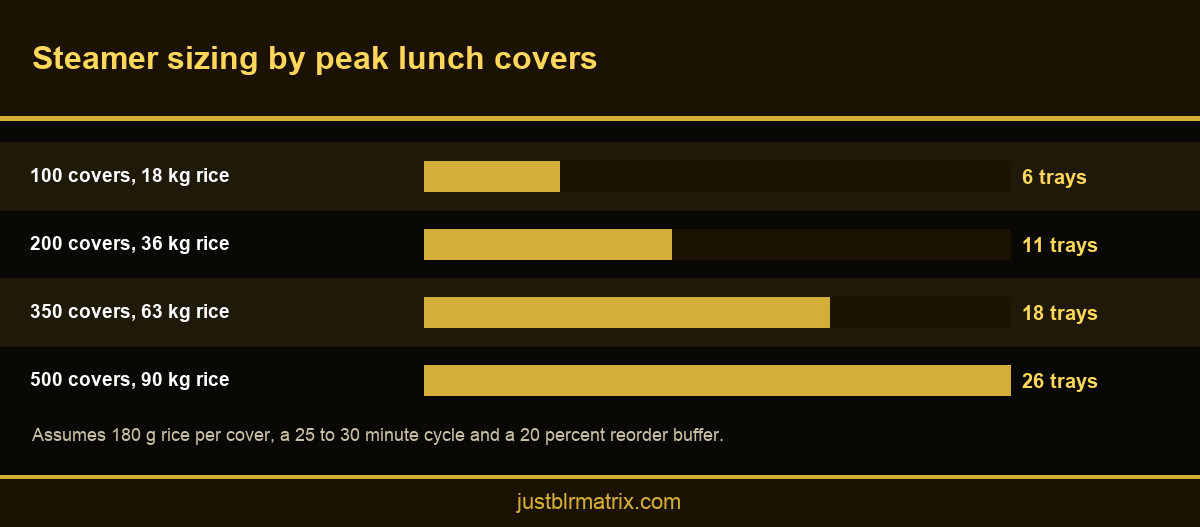 Bar chart showing how many trays an automatic commercial steamer needs at different peak lunch cover counts
Running costs, energy and the case against open flame
An electric steamer removes the open flame from a prep station entirely. That matters well beyond fire safety. Flame heat radiates into the room and the extraction system has to remove it, which is why gas free kitchens usually report a lower ambient temperature, a lower air conditioning load and noticeably better staff retention on the hot line during summer months.
Energy is easy to model honestly. Take the connected load in kilowatts, multiply by the realistic duty cycle, which is usually 55 to 70 percent during service rather than 100 percent, and apply your commercial tariff. Most operators overestimate the bill badly because they assume the element runs continuously from open to close. It does not.
Compare that figure against cylinder consumption on your current method. Many Indian outlets still run bulk cooking on LPG, where the cost per usable megajoule looks attractive until you account for the large share of heat that never reaches the pot at all. Efficiency at the burner and efficiency at the food are different numbers.
Water is the hidden line item that ruins otherwise sound business cases. Hard water scales the boiler, scaling drops thermal efficiency, and dropped efficiency quietly extends cycle times until somebody finally descales the unit. A softener at installation and a quarterly descale schedule protects the payback period you modelled on paper.
Labour is where the number actually lands. One cook released from rice duty across two services, six days a week, is a recurring saving that no energy calculation will ever match. Model that first, treat energy as the secondary benefit, and the investment case usually clears without any creative accounting at all.
A buying checklist for Indian conditions
Ask for the tray rating in idli racks and in flat gastronorm, quoted separately. Ask for the steam recovery time between cycles at full load rather than empty. Ask what the unit does on a power dip and on low water. Those three answers will tell you more about daily life with the machine than any brochure specification ever does.
Check the drain design carefully before anything else mechanical. Indian kitchens run high starch loads from rice and batter, and a narrow drain on a rice steamer will block within weeks of commissioning. A wide, removable, tool free drain assembly is worth paying a premium for and is almost never mentioned in a sales conversation.
Confirm that every food contact surface is stainless of a documented grade, and that the cavity can be cleaned to the standard your FSSAI audit expects. Sanitation is far easier to design in at purchase than to retrofit later. Removable racks and rounded internal corners save the closing team real time every single night.
Get the service map in writing rather than as a verbal assurance. Where is the nearest engineer based, what is the response commitment in hours, and which spares are held in India rather than shipped on order. Downtime on a rice steamer stops the entire menu, not one dish, so response time is the specification that matters most.
Finally, look at the steamer as one station inside a wider kitchen modernisation plan rather than as an isolated purchase. It pairs naturally with bulk sauce production and with cook chill, and the sequencing decision is much cheaper to make once, at design stage, than three times across three separate procurement rounds.
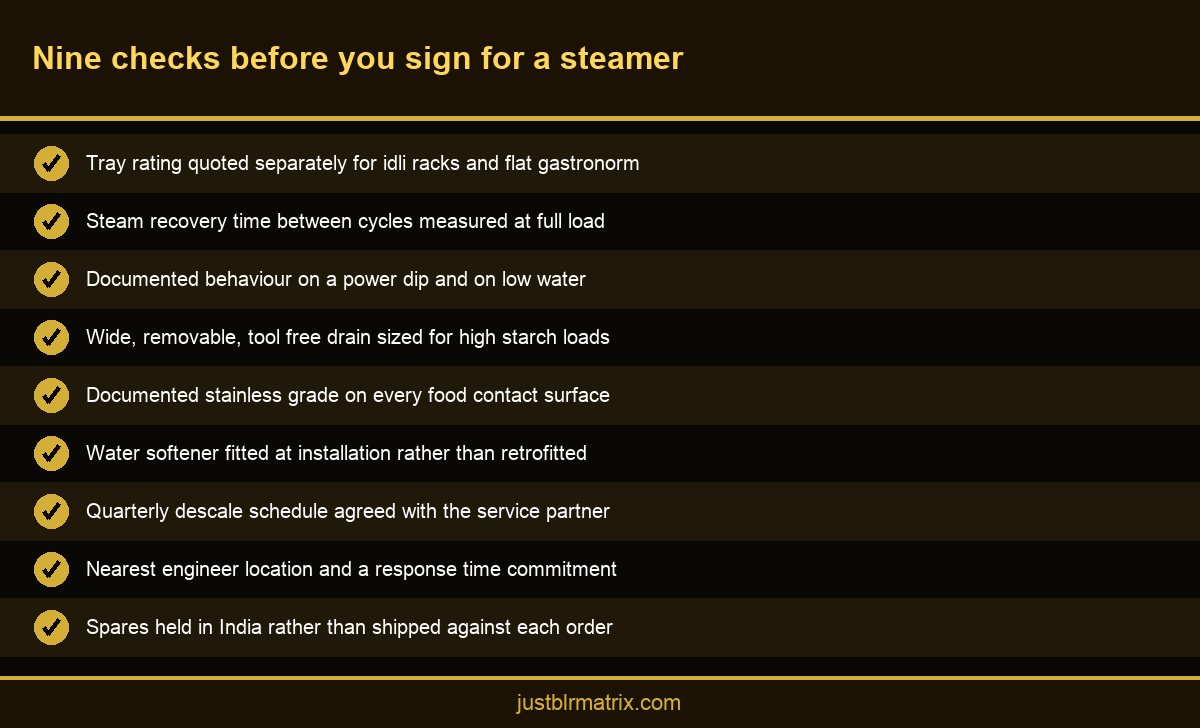 Checklist infographic showing nine buying checks for an automatic commercial steamer in an Indian kitchen
Conclusion
An automatic commercial steamer earns its place when rice and idli volumes are steady and predictable, which describes most Indian restaurant, hotel and cloud kitchen operations. Size it on trays per peak hour rather than on litres, protect it with water treatment from the first day, and count the labour release as the primary return rather than the energy saving. If you would like the tray maths run against your own cover counts, request a demo and our team will size the unit with you.
Frequently Asked Questions
What is an automatic commercial steamer used for in Indian kitchens?

How many trays do I need for a two hundred cover lunch service?
Is an electric steamer cheaper to run than an LPG setup?
How often does a commercial steamer need descaling?
Can one steamer handle both rice and idli production?
What stainless steel grade should the food contact surfaces be?
How does a steamer fit alongside other prep automation?
What is the biggest maintenance risk on a rice steamer?
Does a steamer actually reduce kitchen staffing?