Commercial Fruit and Food Dehydrators for Menu Development
 Kitchen Automation & Smart Cooking
A food and fruit dehydrator is one of the few pieces of kitchen equipment that makes money on both sides of the ledger. It creates high margin garnishes, snacks and menu components, and it turns produce that would otherwise be discarded into a shelf stable ingredient. This guide covers how dehydrators are specified, realistic drying times for the items Indian kitchens actually use, and how a bar and kitchen can share one machine sensibly.
Key Takeaways
- A dehydrator is a bridge between the bar and the kitchen, which is unusual and makes the utilisation case easier.
- Tray area and airflow decide capacity, not the wattage figure that most product listings lead with.
- Waste reduction is the quiet argument, because surplus produce becomes a shelf stable menu ingredient instead of bin weight.
- Drying is slow, so schedule it overnight and treat the machine as a background process rather than a service tool.
What a dehydrator is actually for in a restaurant
A food dehydrator removes moisture using warm air moving across trays, at a temperature low enough that the food does not cook. The result is a concentrated, shelf stable version of the original with intensified flavour, which is why it works as both a garnish and a flavour component rather than just a preservation method.
In a bar programme the immediate application is garnish. Dried citrus wheels, dehydrated pineapple, apple crisps and herb powders all lift a drink's appearance and last for weeks rather than hours. That shelf life is the operational point, because fresh garnish is discarded daily while dried garnish is not.
In the kitchen the applications are broader. Dried tomato, mushroom and chilli concentrate flavour for stocks and sauces. Fruit leathers and crisps become dessert components. Vegetable powders season without adding liquid, which matters in plating where moisture control affects presentation.
The waste argument is where the machine justifies itself financially. Fruit approaching the end of its usable life, trim from prep, and surplus from an over order all become inputs rather than waste. A kitchen that regularly discards produce is discarding an ingredient it could be selling.
There is also a differentiation argument that matters more in a competitive market. House made dried garnishes and components are visibly not bought in, and guests notice. For a bar or restaurant trying to signal care without adding labour to the service window, it is an efficient way to do it.
The limitation is time. Drying takes hours, not minutes, so the machine is a background process. Kitchens that expect to dry something during service will be disappointed, and the ones that succeed treat it like a scheduled overnight task alongside stock and prep.
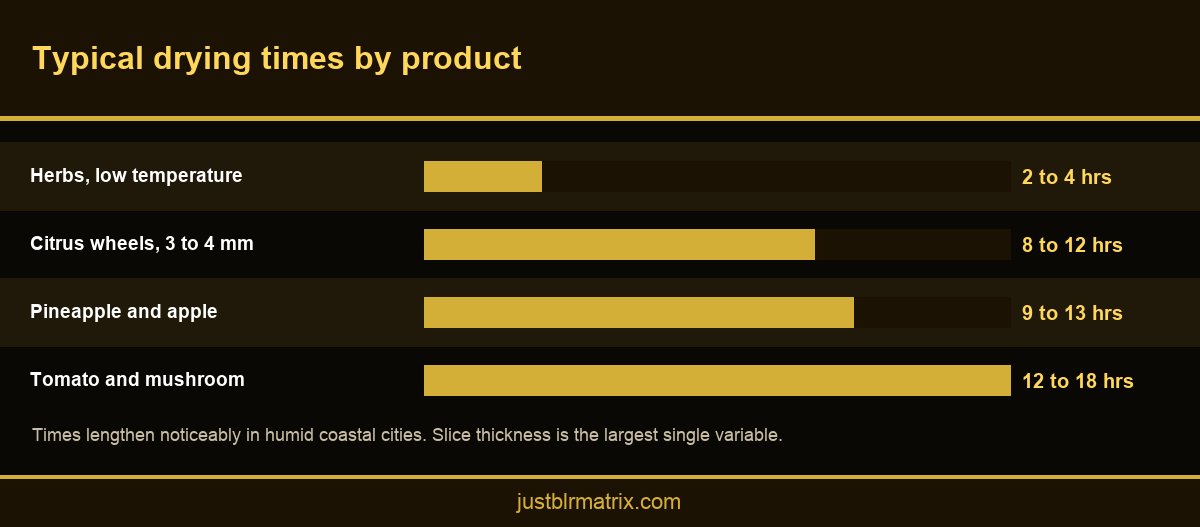 Bar chart of typical commercial dehydrator drying times for herbs, citrus, fruit and vegetables
Tray area, airflow and honest capacity
Capacity is tray area, not wattage. A machine with ten large trays holds far more than one with fifteen small ones, and product listings frequently lead with tray count because it sounds better. Ask for the total usable tray area in square metres and compare on that basis.
Airflow design decides evenness. Horizontal airflow, where a fan pushes air across the trays from the rear, dries the whole load consistently. Vertical airflow, where air rises through stacked trays, dries the bottom trays faster and requires rotation partway through the cycle.
For a commercial kitchen, horizontal airflow is almost always the right choice. Tray rotation is a task that will be forgotten on a busy night, and a machine that needs babysitting will produce inconsistent output or will simply stop being used after the novelty passes.
Temperature range matters for versatility. Around forty degrees suits herbs and delicate items, fifty five to sixty suits most fruit, and higher settings are needed for anything meat based. A machine with a narrow range limits what the kitchen can develop later.
Timer and auto shut off are practical necessities rather than luxuries. Overnight drying only works if the machine stops itself, and a load left running an extra four hours because nobody was in the kitchen produces brittle, over dried product that has to be thrown away.
Finally, plan where it sits. A dehydrator running overnight generates warm air and a strong aroma, both of which are unwelcome in a walk in corridor or near dry storage. A ventilated corner away from ambient sensitive storage is the sensible position.
Drying times and what actually works
Citrus wheels at three to four millimetres take roughly eight to twelve hours at sixty degrees, depending on humidity and thickness. Thickness is the variable that matters most, and a slicer that cuts consistently is therefore a prerequisite rather than a nice extra for a bar producing garnish at volume.
Pineapple and apple take a similar window, though sugar content changes the finish. Higher sugar fruit stays slightly pliable rather than becoming crisp, which is often desirable for a garnish and undesirable for a crisp, so the target texture should be decided before the batch goes in.
Herbs dry fast, in two to four hours at low temperature, and are among the highest value outputs because fresh herbs are expensive and perish quickly. Drying surplus herb stems and leaves at the end of a prep session recovers value from an item most kitchens discard without thinking.
Tomato and mushroom take longer, often twelve to eighteen hours, because of their water content. Both are worth it because the concentrated result is a flavour base that replaces bought in products, and the cost difference between house dried and purchased is substantial.
Anything meat based needs care. Higher temperatures and handling documented against food safety regulations apply, and unless the kitchen has a genuine reason to make its own dried meat it is usually simpler to leave that category alone and focus the machine on fruit, vegetables and herbs where the safety picture is straightforward.
Humidity is the Indian variable nobody mentions. Coastal cities extend every drying time noticeably, and a machine that performs to specification in Delhi in January will be slower in Kochi in July. Plan schedules with that margin, as you would for any cold chain or holding equipment decision.
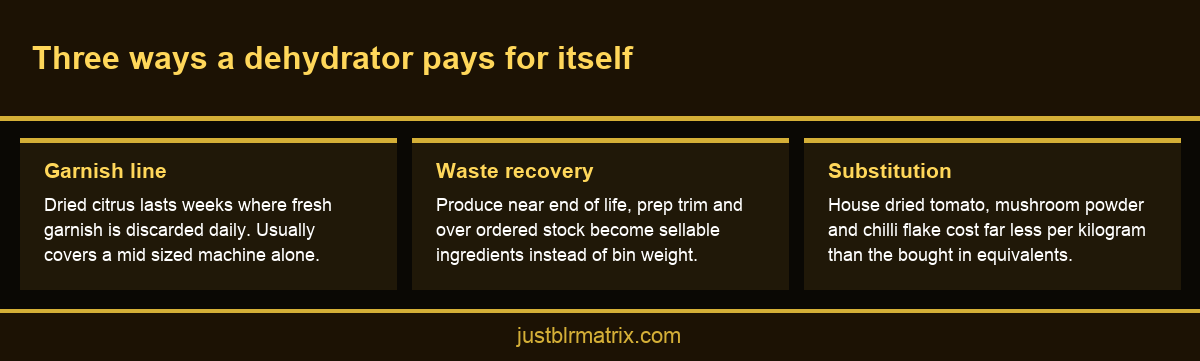 Infographic showing three ways a commercial fruit drying machine pays for itself in a restaurant
Making the machine pay and buying checks
Start with the garnish line. Count what your bar spends on fresh citrus discarded daily, and compare that against a weekly batch of dried wheels produced from the same fruit. Most bars find the switch pays for a mid sized machine within a few months on garnish alone.
Add the waste recovery. Track produce written off over a month, identify what could have been dried, and value the resulting ingredient at what you would otherwise pay for it. This number is usually larger than operators expect and is entirely invisible until somebody measures it.
Then add the substitution line. Dried tomato, mushroom powder and chilli flake bought in are not cheap, and house production at scale is significantly cheaper per kilogram. List what you currently buy that the machine could produce, and price the difference honestly.
For buying checks, confirm the tray material and whether trays are food safe and dishwasher capable. Sticky fruit residue on a mesh tray is a genuine cleaning problem, and non stick tray liners are worth specifying with the machine rather than sourcing later.
Check the noise level if the machine runs overnight in a building with residential neighbours or guest rooms above. Fans running for twelve hours are not loud individually but are persistent, and that has caused complaints in more than one hotel installation.
Finally, decide who owns it. A dehydrator that belongs to nobody gets used by nobody. Assigning it to the bar or to a specific kitchen section, with a named person responsible for scheduling and cleaning, is what separates a productive machine from an expensive shelf. The same is true across kitchen technology generally.
Conclusion
A commercial fruit drying machine is a menu development tool and a waste recovery tool at the same time, which is a rare combination. Specify by usable tray area and horizontal airflow, plan drying as an overnight background task, allow extra time in humid cities, and give the machine a named owner. Do that and it pays for itself quickly. Enquire now for a unit sized to your menu.
Frequently Asked Questions
What can a commercial dehydrator make for a restaurant?

How is dehydrator capacity measured?
Is horizontal or vertical airflow better?
How long does it take to dry citrus wheels?
Does humidity affect drying times in India?
Can a dehydrator reduce food waste?
Should I dry meat products?
Where should the machine be positioned?
What makes a dehydrator get used rather than ignored?