Noodle and Ramen Cooking Machines for High Volume Kitchens
 General
A noodle and pasta boiler is really a timing machine. Noodles and pasta have a narrow window between undercooked and ruined, and that window shrinks as a kitchen gets busier. A basket boiler with individual timers holds that window open no matter how loud the pass gets. This guide covers how the timing failure actually happens, how to size a station by basket count against your real peak, how water and starch drive both flavour and running cost, and the specification checks that matter in an Indian kitchen running hakka noodles, ramen and pasta from a single station.
Key Takeaways
- Noodle quality is a timing problem, and timing is exactly what a busy manual line loses first.
- Basket count, not tank litres, decides how many concurrent orders a boiler can genuinely handle.
- Water turnover and starch management drive both taste and running cost across a full kitchen equipment setup.
- Indian menus mix hakka noodles, ramen and pasta in one station, so specify for the widest cook time on the card.
Why noodle timing breaks down in a manual kitchen
Noodles cook in a window measured in tens of seconds, not minutes. Thirty seconds late and a ramen noodle goes soft and loses bite. Thirty seconds early and it is chalky at the core. In a quiet kitchen a cook holds that window comfortably. In a rush, with six tickets and a wok going, the window is the first thing to slip.
The failure mode is invisible to management because it is intermittent. Nobody complains on a slow Tuesday. The complaints arrive on Saturday night, when the kitchen is at capacity and the cook is estimating rather than timing. That pattern is why noodle quality reviews so often contradict each other on the same outlet.
A basket boiler assigns each order its own timer and its own basket. The basket lowers, the timer runs, and the basket lifts automatically at the end of the cycle. The cook is freed from watching a clock and the noodle is cooked identically at eight in the evening and at eleven, which is the entire point.
That consistency matters more for ramen than for anything else on an Indian menu, because ramen guests are texture sensitive and the dish carries a premium price. A soft noodle in a two hundred rupee hakka portion is forgivable. The same fault in a five hundred rupee ramen bowl is not.
The second benefit is that a machine makes the recipe transferable. A cook time written on a card is only as good as the person following it. A cook time programmed into a basket position produces the same result across every outlet in a group, which is what makes multi site consistency achievable at all.
Basket count, tank size and specifying for your peak
Basket count is the specification that matters. Each basket handles one order, so a six basket unit serves six concurrent noodle orders. Tank litres tell you about thermal recovery, not about throughput, and vendors frequently lead with the litre figure because it sounds larger and comparisons become harder to make.
Work from your ticket data. Count the peak fifteen minutes rather than the peak hour, because that is when the station saturates. If your busiest quarter hour carries twenty noodle covers on a three minute average cook, you need roughly five baskets running continuously with no spare capacity at all.
Add headroom for the widest cook time on your menu. Hakka noodles finish in ninety seconds, fresh ramen in about two minutes, and dried pasta in eight to eleven. A station that mixes all three is occupied far longer per order than an average figure suggests, and averaging is where sizing errors originate.
Thermal recovery is where tank size does matter. Dropping six cold baskets into a small tank collapses the temperature and every cook time on the machine becomes wrong at once. Ask for the recovery time from a full cold load, measured, and treat any supplier who cannot answer that question as a supplier to avoid.
Finally, consider whether the same station will carry pasta for a European section of the menu. If so, specify a noodle and pasta boiling machine rather than a ramen specific unit, because basket geometry differs and a shallow ramen basket handles long dried pasta poorly during the initial submersion.
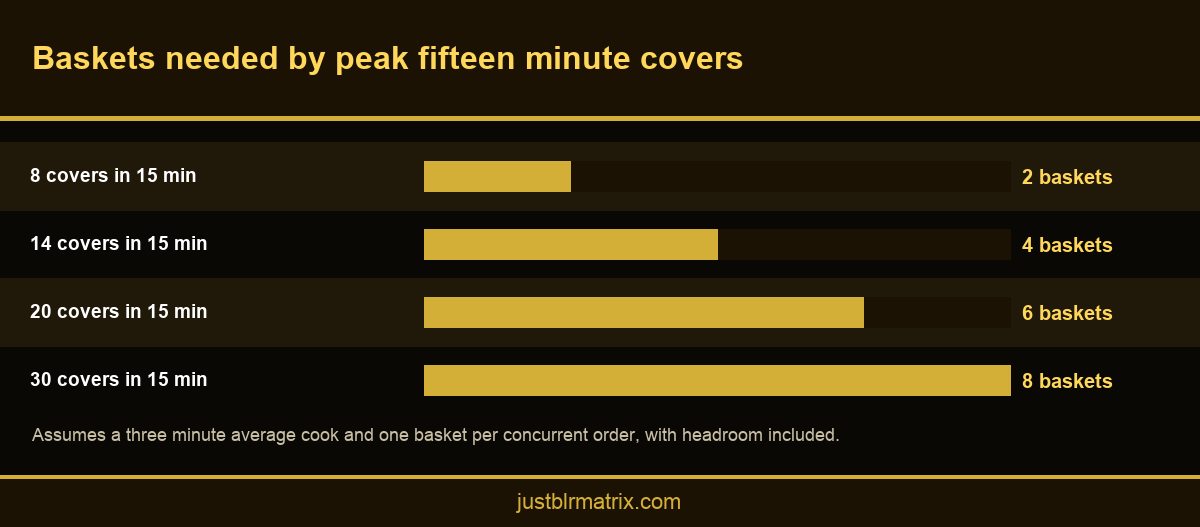 Bar chart showing how many baskets a commercial noodle cooking machine needs by peak covers
Water, starch and running costs
Noodle water is a consumable, not a fixture. Starch accumulates through service, the water thickens, and thickened water coats noodles and dulls flavour. Most kitchens change it far less often than they should because emptying and refilling a hot tank mid service is unpleasant and slow without the right drain design.
Look for continuous overflow and a bottom drain rather than a single tap. Continuous overflow skims the starch foam off the surface as it forms, which extends usable water life dramatically. A bottom drain lets the settled starch out without draining the whole tank down and losing your service temperature.
Model the water cost honestly and it is usually smaller than operators fear. A typical station changes water two or three times a day plus overflow makeup. The energy to bring that back to temperature is the real cost, not the water itself, and a well insulated tank cuts it substantially over a year.
Energy modelling follows the same logic as any heated appliance. Take the connected load, apply a realistic duty cycle rather than assuming continuous full power, and compare it against the gas burners the station currently runs. Electric boilers usually win once extraction and ambient heat load are included in the comparison.
Descaling matters here too. A scaled element heats slower, recovery time lengthens, and every programmed cook time silently drifts out of calibration. Build a descale interval into the maintenance schedule at commissioning rather than waiting until the kitchen notices that the noodles have started arriving underdone.
Buying checks for Indian kitchens
Insist on individually timed baskets rather than a single shared timer. Shared timers force the cook back into estimating for every order that does not start at the same moment, which reintroduces the exact problem the machine was bought to solve. This is the most common specification mistake in the category.
Check the lift mechanism. Automatic basket lift at the end of the cycle is what removes the human from the timing loop. A machine that only sounds an alarm still depends on somebody hearing it during a rush, which on a loud Saturday line is not a dependable control at all.
Confirm basket material, mesh gauge and whether baskets are replaceable individually. Baskets take the most abuse of any part on the machine, and a unit whose baskets are only sold as a full set becomes expensive to keep in service after the first year of heavy use.
Ask about the guard and splash design. Boiling water at counter height in a busy kitchen is a genuine safety issue, and the guidance that catering safety authorities publish on burns and scalds is worth reading before you finalise a layout that puts the boiler next to a walkway.
Finally, place the noodle station in the context of the wider line. It works alongside wok ranges, sauce kettles and the cooking bot range rather than in isolation, and deciding the whole station sequence once at design stage is far cheaper than moving water and power services later.
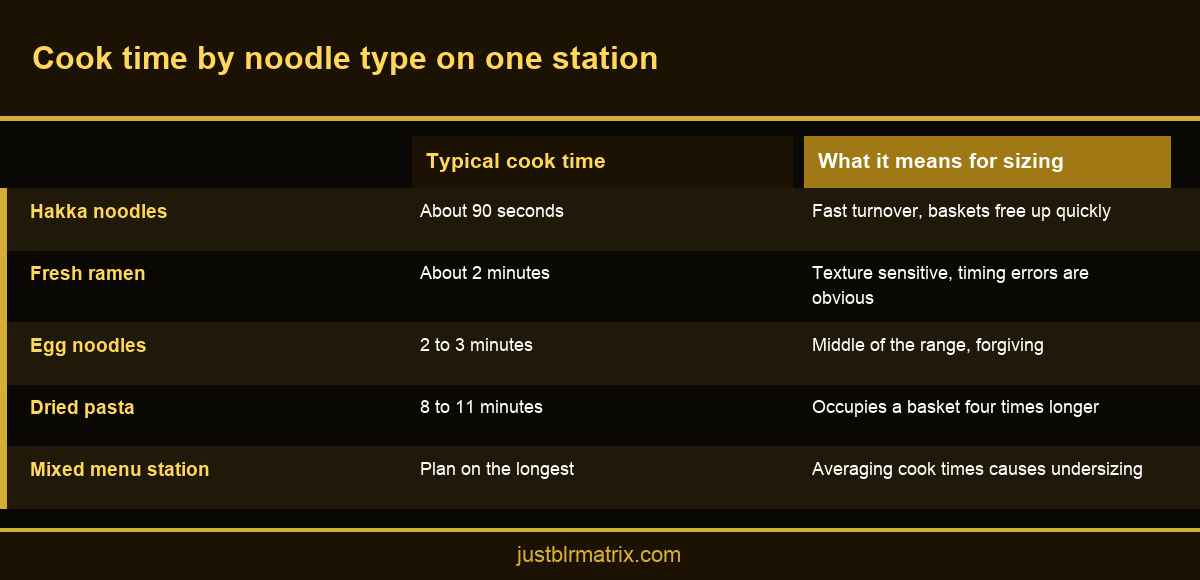 Comparison infographic of cook times for hakka noodles, ramen and dried pasta on a single boiler station
Conclusion
A commercial automatic noodle making machine buys timing consistency, and timing is what a manual line loses exactly when it can least afford to. Specify by basket count against your peak fifteen minutes, insist on individual timers with automatic lift, and design the water management in at the start rather than bolting it on after the first month of service. Descaling belongs in the maintenance schedule from commissioning, because a scaled element quietly pushes every programmed cook time out of calibration. Request a demo and we will size a station against your own ticket data.
Frequently Asked Questions
What does a commercial noodle cooking machine do?

How many baskets do I need?
Does tank size matter more than basket count?
Can one machine cook hakka noodles, ramen and pasta?
How often should noodle water be changed?
Is an electric noodle boiler cheaper than gas burners?
What is the most common specification mistake?
Why does descaling affect noodle quality?
Where should the noodle station sit in the kitchen?