Commercial Pizza Cone Makers: Setting Up a Cone Pizza Line
 General
A cone pizza machine forms dough into an edible cone that is filled, baked and handed over in one piece. It is a format decision more than an equipment decision. The cone eats cleanly while walking, it needs no plate and no cutlery, and it photographs well. This guide covers how a cone line actually runs, what output and staffing it needs, and where the format works in India and where it does not.
Key Takeaways
- A cone pizza line is a format play for footfall locations, not a replacement for a conventional pizza menu.
- Output is set by the number of cone moulds and the bake cycle, so mould count is the specification that matters.
- Cones cut packaging and cutlery cost to almost nothing, which changes unit economics in a food court or QSR setting.
- The format fails in delivery and succeeds in walk up trade, so match it to your location before you invest.
What a cone pizza line is and how it runs
A cone maker presses or wraps dough around a conical former, then bakes it into a rigid edible shell. The shell is held upright in a stand, filled with sauce, cheese and toppings, and finished in an oven or a holding unit. The guest receives a sealed base with the filling inside, which is the whole point of the format. Nothing spills and nothing needs a plate.
The line has three stations rather than one. Forming produces the shells, usually in batches ahead of service. Filling happens to order at the counter. Finishing bakes or reheats the filled cone. Understanding that split is essential, because operators who buy only the forming machine discover they have solved a third of the problem.
Shells can be formed in advance and held. That is the operational advantage over conventional pizza, where the base and the topping are committed together. Pre formed shells let a small counter serve a queue quickly, because the slow step has already happened before the rush arrives. Peak throughput is therefore much higher than the forming rate suggests.
The equipment is compact by foodservice standards. A forming unit, a holding stand and a small oven fit into a counter run of about two metres. That footprint is why the format suits mall kiosks, food courts, campus outlets and event stalls, where a full pizza kitchen would never be viable on the rent.
None of this displaces a conventional line. A pizza menu built on flat bases and a dough press serves seated dining and delivery. The cone serves the guest who is walking, standing or queuing. Most operators who succeed with cones run them as a second format at a second counter rather than as a replacement.
Output, mould count and staffing maths
Forming output is a simple function of mould count and cycle time. A six mould unit on a four minute cycle produces ninety shells an hour. A twelve mould unit on the same cycle produces one hundred and eighty. That figure is your ceiling for pre forming, not your service throughput, which is governed by the filling and finishing stations instead.
Service throughput is usually the binding constraint. One person filling to order manages roughly sixty to eighty cones an hour before quality drops. If your peak demands more than that, you need a second filling position rather than a bigger forming machine. Operators routinely buy the wrong upgrade because the vendor sells the forming unit.
Shell holding time determines how far ahead you can work. A well formed shell holds crisp for several hours in a dry cabinet and goes soft quickly in humidity. In coastal Indian cities that difference is severe, so ask the supplier for a holding time measured in local conditions rather than a laboratory figure.
Staffing for a kiosk format is typically two people at peak and one off peak. One forms and finishes, one fills and serves. Compare that against a conventional pizza counter needing a dough specialist, an oven operator and a server, and the labour difference is where the format economics genuinely come from.
Plan shell wastage into the model. Pre formed shells that do not sell are a loss, unlike dough balls which keep. Most operators settle at forming to a rolling forecast rather than a fixed batch, and the first month is spent learning what that forecast looks like on a weekday against a weekend.
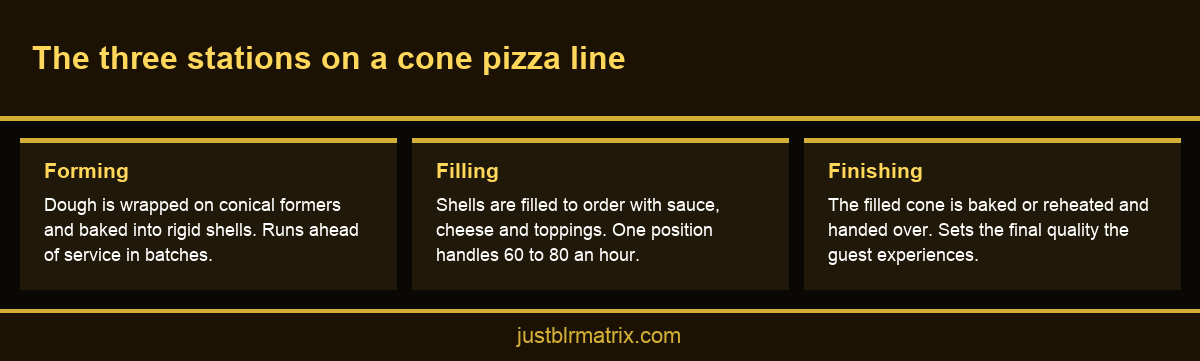 Infographic showing the three stations of a commercial pizza cone line: forming, filling and finishing
Where the format works in India, and where it does not
Cones work where the guest is moving. Mall food courts, cinema foyers, metro concourses, college campuses, exhibition halls and event catering all suit a handheld sealed product. In each of those settings the absence of a plate, a fork and a table is an advantage rather than a compromise, and queue speed matters more than menu breadth.
Cones fail in delivery. The shell softens in a closed box, the filling settles, and a product designed to be eaten within minutes arrives twenty five minutes later in poor condition. Any operator planning to run cones through an aggregator platform should test that journey honestly before committing to the equipment.
The format also struggles in a seated casual dining room. Guests who have sat down expect to share, and a cone is a single serve item that does not divide. It can work as a starter or a novelty, but it will not carry a main course slot in a restaurant where the table is the unit of sale.
Menu engineering matters more than usual because the format is unfamiliar. Indian guests respond well to recognisable fillings presented in a new shape, so paneer tikka, chicken tikka and a spiced corn option typically outsell an unfamiliar continental filling by a wide margin in the first six months of trading.
Pricing sits between a snack and a pizza. Guests anchor on street food pricing when they see a handheld item and on pizza pricing when they read the word pizza. Most successful operators price closer to a premium snack and let portion size carry the value perception rather than competing on a per inch comparison.
Buying checks for a commercial cone maker
Confirm the mould material and coating. Stainless formers with a food safe release coating are the standard, and a worn coating means shells that stick and tear. Ask what the coating is, how long it lasts in continuous service, and whether formers are sold individually or only as a full set.
Ask for the cycle time at full mould load rather than with a single cone. Recovery between batches is where cheap units lose their advertised output, and the difference between the brochure number and the real one is frequently thirty percent or more once the machine is working continuously through a lunch peak.
Check the power provision and the heat load. A forming unit plus a finishing oven on a kiosk counter can exceed the supply a mall unit provides. Establish the total connected load before you sign a lease, because upgrading a supply inside a shopping centre is slow and expensive.
Verify that every food contact surface can be cleaned to the standard your FSSAI inspection expects. Cone formers have an awkward geometry, and a design that cannot be stripped and washed properly will fail an audit. Removable formers are far easier to defend than a fixed assembly.
Finally, treat the cone line as one option inside a broader kitchen modernisation plan rather than an isolated novelty. The same counter can carry other automated formats, and deciding the whole layout once is cheaper than retrofitting a second machine into a two metre run six months later.
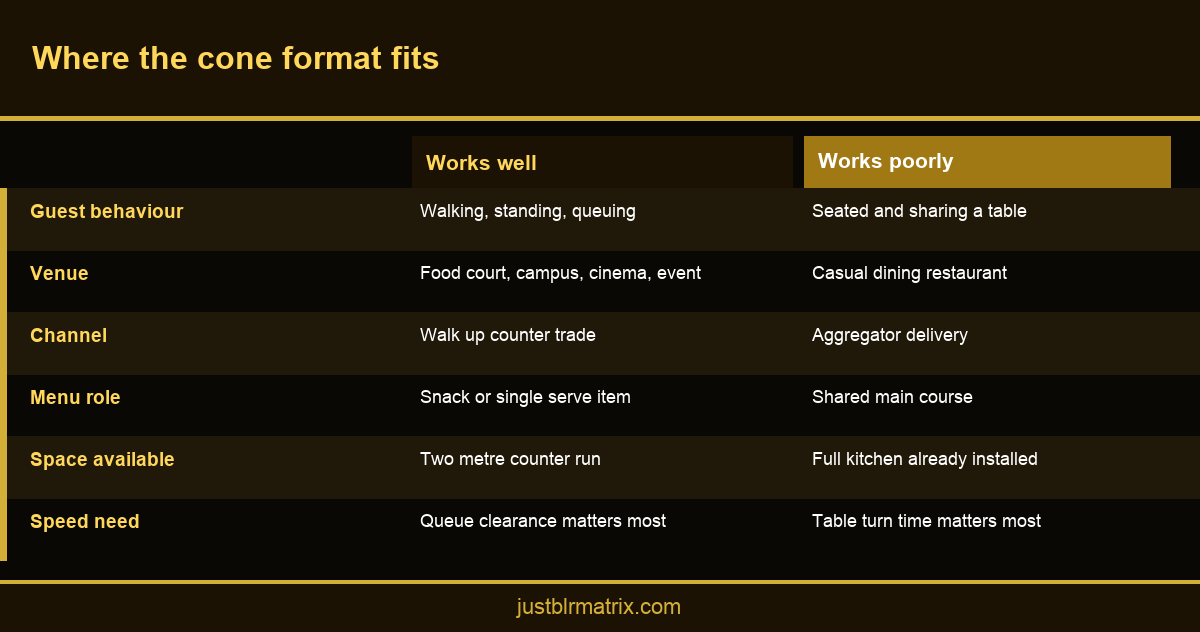 Comparison infographic showing which venues suit a cone pizza format and which do not
Conclusion
A commercial pizza cone maker is a format investment that rewards footfall and punishes delivery. Pre formed shells let a two person kiosk clear a queue that a conventional pizza counter could not, and the packaging saving is real. Size the machine on mould count, size the counter on filling positions, and test the format against your actual location before you buy. Enquire now for a line layout matched to your site.
Frequently Asked Questions
What is a commercial pizza cone maker?

How many cones per hour can a machine produce?
Can pizza cone shells be prepared in advance?
Does cone pizza work for delivery orders?
What staffing does a cone pizza kiosk need?
Which fillings sell best in India?
How much counter space does a cone line need?
What should I check on the formers themselves?
How does a cone line fit with other kitchen equipment?