Restaurant Self Service Automation: The Complete India Guide
 Service Automation in Restaurants
Restaurant self service automation is no longer an experiment in India. Guests already order food, book cabs and pay bills from their phones, and the counter is the last place they are asked to queue. This guide covers the four self service formats that matter in Indian food and beverage, how settlement hardware talks to your point of sale, what GST invoicing requires, what the guest experience actually changes, and how a multi outlet group should sequence a rollout without breaking service.
Key Takeaways
- Self service is a settlement problem before it is an ordering problem, and settlement is where the queue forms.
- Four formats matter in India: counter kiosk, tabletop tab, counter checkout and vending. Each fits a different venue.
- Integration decides success, because hardware that does not talk to your POS platform creates two sets of books.
- Staff are redeployed rather than removed, and the outlets that plan that redeployment are the ones that see a return.
Why Indian food and beverage is moving to self settlement
The behavioural shift came first and the hardware followed. Indian consumers moved to digital payment faster than almost any market, and a guest who pays for groceries, fuel and travel by phone finds it strange to wait for a bill folder in a restaurant. The expectation gap is now the friction, not the technology.
Unified Payments Interface adoption is the single largest enabler. It removed the card terminal as a bottleneck, made small value transactions frictionless, and normalised scanning a code to pay. Every self service format in India is built on that assumption, which is why formats imported from markets without it often fit poorly.
Labour economics pushed from the other side. Front of house staffing costs rose, availability tightened and attrition stayed high, particularly in metro markets. An outlet that cannot reliably staff a till at nine on a Saturday has a strong reason to remove the till from the critical path entirely.
Peak concentration is the operational reason. Most Indian food and beverage revenue arrives in narrow windows, and the counter saturates in those windows while sitting idle for hours either side. Self service adds capacity exactly where it is needed without adding a person who is underused for the rest of the shift.
The result is that self service in India is settlement led rather than ordering led. Guests are usually happy to order from a person, and increasingly unwilling to wait to pay one. Understanding that distinction is what separates a rollout that works from one that puts an expensive screen where nobody uses it.
This is also why formats that succeeded abroad sometimes stall here. A large ordering kiosk designed for a market with high labour costs and low digital payment penetration solves a problem Indian outlets do not primarily have. The format has to be selected against the local friction rather than against a global case study, however impressive the numbers in that study look.
The four self service formats and where each fits
There are four formats worth considering in Indian food and beverage, and they are not interchangeable. Each suits a different venue type, a different guest behaviour and a different point in the service journey. Choosing the wrong one is the most expensive mistake in this category.
The distinction that matters most is where the guest is standing when they interact. A guest at a counter, a guest at a table and a guest walking past a machine are three different situations with three different design requirements. Treating them as one problem produces hardware that fits none of them well.
Counter ordering kiosks
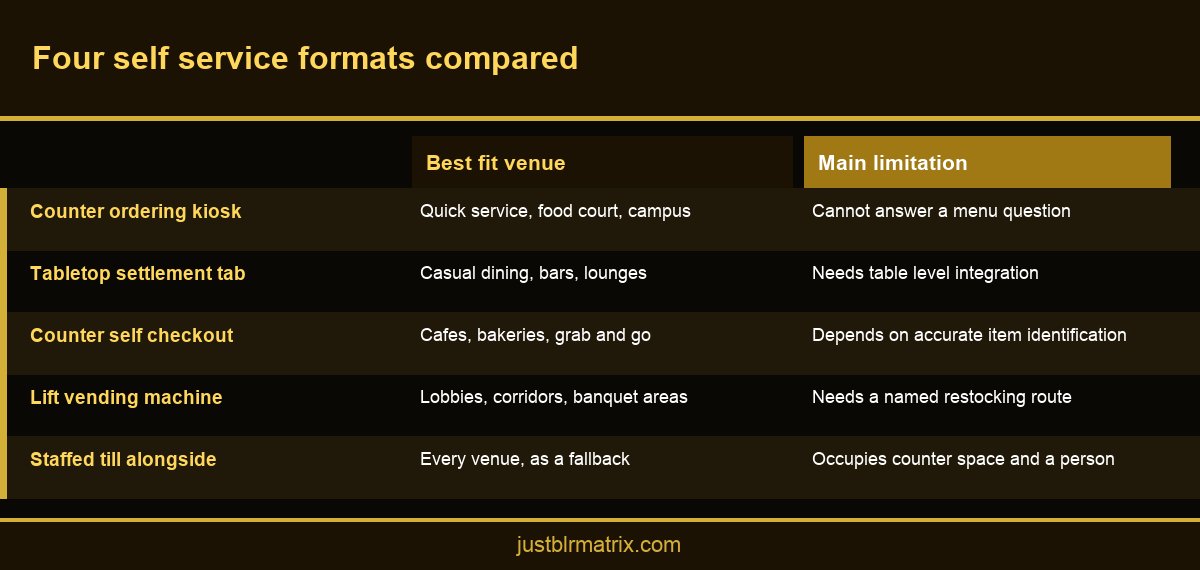
A freestanding or wall mounted screen where the guest browses the menu, configures the order and pays. It suits quick service, food courts and campus outlets where the menu is standardised and the queue is the problem. It works poorly where the menu needs explanation or where guests expect a recommendation, because a screen cannot answer a question about what the paneer is like today. Kiosks also need floor space in front of them, which is easy to forget when a specification sheet quotes only the footprint of the unit. Allow room for a guest to stand and browse without blocking the entrance or the queue behind.
Tabletop settlement tabs
A small device at the table that lets a seated guest view the running bill and settle whenever they choose. This is the format most under used in India and the one that removes the most friction in casual dining, because the wait for a bill is longer and more irritating than the wait to order. It also lifts table turn without rushing anyone, because guests leave when they are ready rather than when a server finally appears. The requirement it imposes is table level integration, since the device must know which table it belongs to and which open orders sit against that table at any given moment.
Counter self checkout
A settlement only station where a guest who has already ordered pays without queueing at the till. It suits cafes, bakeries and grab and go formats where the transaction is simple and the guest is holding a tray. It requires accurate item identification, which is the part that determines whether it feels fast or frustrating. Code scanning works well for packaged items and poorly for a plate of food, which is why the format suits bakeries and grab and go counters far better than a restaurant plating cooked dishes onto a tray.
 Comparison infographic of four restaurant self service formats used in Indian food and beverage
Vending and unattended formats
The fourth format is unattended vending, and it belongs in the same conversation because it is settlement automation with the service attached. A lift served vending unit in a hotel lobby, a bar corridor or an office floor sells at hours when no counter is staffed at all.
Modern lift vending differs from the machines most people picture. Product is carried to the collection point rather than dropped, which allows fragile and premium items to be sold. That single mechanical change opens the category to bottled cocktails, desserts, packaged meals and glassware rather than only crisps and cans.
In hospitality the strongest use cases are the gaps. Late night in a hotel, between service periods in a bar, and in banquet areas where a full counter is not viable. In each case the comparison is against no sale at all, which makes the business case unusually simple.
Placement discipline is the same as for coffee. High traffic, visible, on a natural path and near where people already wait. A machine sited for convenience of installation rather than for guest flow will underperform badly while carrying identical fixed costs every month regardless of how little it sells.
Product mix decides utilisation more than location alone. A machine stocked with what the venue assumes guests want will sell modestly. One stocked from actual demand data and refreshed monthly sells considerably more, and the reporting needed to do that comes free with any modern cashless machine.
Restocking and cash handling are the operational realities. A cashless machine removes the cash handling problem entirely and is the sensible default in India given payment behaviour. Restocking still needs a named route, and building it into an existing housekeeping round is the usual answer.
How settlement hardware talks to the point of sale
Integration is where self service projects succeed or quietly fail. A kiosk that takes an order and prints a ticket, without writing that order into the same system the counter uses, creates two sets of numbers. Reconciliation then becomes a manual task and the reporting nobody trusts becomes the reporting nobody uses.
The correct architecture is one order source of truth. Every channel, whether counter, kiosk, tabletop tab or vending, writes into the same AI Command POS platform so that stock, sales, tax and kitchen routing are consistent. The client's own coverage of that platform explains the architecture in detail.
Kitchen routing is the practical consequence most operators discover late. An order placed at a kiosk must reach the correct kitchen section with the correct modifiers and the correct sequencing, exactly as a counter order does. If the integration drops modifiers, the kitchen loses confidence in the channel within a week.
Payment rails need their own attention. Card, UPI and wallet all behave differently on failure, and a guest standing at a kiosk with a failed payment needs a clear route out. Reconciliation against your settlement reports, in line with the way payment systems are regulated in India, should be a daily automated check rather than a monthly manual one.
Finally, plan for offline behaviour. Connectivity in Indian outlets is not always reliable, and a self service terminal that becomes a brick during an outage is worse than no terminal at all. Ask specifically what happens offline, and how orders reconcile when the connection returns, alongside your order tracking setup.
GST invoicing, compliance and the paperwork nobody enjoys
Every self service transaction produces a tax invoice, and Goods and Services Tax requirements do not relax because a machine took the order. The invoice must carry the correct particulars, the correct rate for the item category, and it must be issued at the point of supply rather than reconstructed later from a report.
Rate handling is the detail that catches operators out. Food and beverage attracts different treatment depending on the supply, and a kiosk configured with a single blanket rate will produce incorrect invoices at volume. Configure the rates against the item master and verify them against the GST portal guidance before go live.
Digital invoice delivery is now expected and is worth doing well. A guest who receives the invoice by message or email has a record, and the venue has a delivery confirmation. It also removes the paper roll cost and the familiar problem of a printer running out during the busiest twenty minutes of the day.
Refunds and voids need a defined path. A guest who is charged twice at a kiosk cannot be told to come back tomorrow, so the outlet needs a manager level function that reverses the transaction cleanly and produces a credit note. Test this before launch rather than discovering the gap in week one.
Audit trail completeness matters most for multi outlet groups. Every self service channel should be reconcilable to the rupee against settlement reports, and any gap should raise an exception rather than sit quietly in a spreadsheet. That discipline is what makes the channel trustworthy to a finance team.
Record retention is the last piece and the easiest to overlook. Invoice data, settlement reports and exception logs all need to survive the statutory period in a form somebody can retrieve, which means an export routine rather than a vendor assurance. Ask where the data lives and how you get it out before signing anything.
 Six step infographic showing how a multi outlet group should roll out self service automation
What actually changes at the counter
Guest behaviour changes in ways that are consistently reported and consistently surprising. Average order value tends to rise at kiosks, because a screen presents modifiers and add ons without social pressure and a guest browsing alone explores more of the menu than one being watched by a queue.
Order accuracy improves for the same reason. The guest enters exactly what they want and confirms it visually, which removes the mishearing and the assumption that cause remakes. That reduction in remakes is a real cost saving that rarely appears in the original business case.
Queue psychology changes even when total throughput does not. Two shorter queues feel faster than one long one, and a guest who is doing something feels less delayed than a guest who is waiting. Both effects improve perceived service quality independent of any measured time saving.
Some guests will always prefer a person, and designing for that is not a failure. Keeping one staffed position alongside self service serves guests who need help, guests paying cash and guests with accessibility requirements. Removing the human option entirely generates complaints that outweigh the saving.
Staff roles change rather than disappear. The person who ran the till becomes a floor host who helps at the kiosks, expedites orders and handles exceptions. Outlets that plan and train for that role see the benefit. Outlets that simply remove a position see the queue reappear in a different place.
Training the exception, not the routine
Self service handles the routine transaction perfectly and struggles with everything unusual. Staff training should therefore focus almost entirely on exceptions, which means payment failures, split bills, refunds, allergy questions and guests who simply want help. Training people to operate the kiosk is wasted effort because guests operate it themselves. Write the exception list before launch, rehearse each one, and make sure every shift has somebody who can execute a refund without escalating to a manager who may be off site. Guests judge the whole channel by how quickly an exception is resolved.
Designing for the first time user
A significant share of guests will be using your specific interface for the first time, and they will not read instructions. The first screen must make the next action obvious, the menu structure must match how guests think about the food rather than how the kitchen is organised, and the payment step must be unmistakable. Watch ten real guests use it before you sign off the interface, because the mistakes they make will be consistent and almost none of them will be the mistakes your own team predicted during configuration.
Accessibility and language
Indian outlets serve guests across languages, ages and abilities. Multi language support is not optional in most metro locations, screen height and reach matter for wheelchair users, and font size matters for older guests. These are inexpensive at design stage and expensive to retrofit after installation. Decide which languages the interface carries based on where the outlet actually is rather than on a group standard, and test the layout in each one, because a translation that overflows a button is simply a broken screen.
Cost, payback and staffing redeployment
Model the cost per transaction rather than the cost of the hardware. Take the installed cost, the software subscription and the maintenance across a realistic life, then divide by the transactions the channel will genuinely handle. That figure is comparable against a staffed till in a way that a capital number is not.
Be conservative about channel share in the first year. A well placed kiosk in a busy quick service outlet may take a large share of transactions, but a tabletop tab in a casual dining room takes longer to build habit. Assuming rapid adoption is the commonest way these business cases disappoint.
Count the average order value uplift, because it is usually real and usually the largest single line. Even a modest percentage increase applied across a high transaction count outweighs the labour saving in most outlets, and it is measurable within the first month by comparing channels directly.
Then subtract the costs nobody budgets. Screen cleaning, consumables, connectivity, payment gateway charges and the occasional hardware failure all recur. So does the floor host role, which is a redeployment rather than a removal and should not be counted as a saved salary.
Finally, compare the whole picture against the alternative uses of the same capital. A kiosk competes for budget with kitchen equipment, with service automation and with front of house refurbishment, and the honest comparison is between those options rather than between the kiosk and doing nothing.
Where the numbers look marginal, consider a rental or subscription model before rejecting the project outright. Spreading the hardware cost turns a capital decision into an operating one, which lowers the barrier to running a proper pilot and keeps the exit cheap if the format does not suit the venue.
A rollout checklist for multi outlet groups
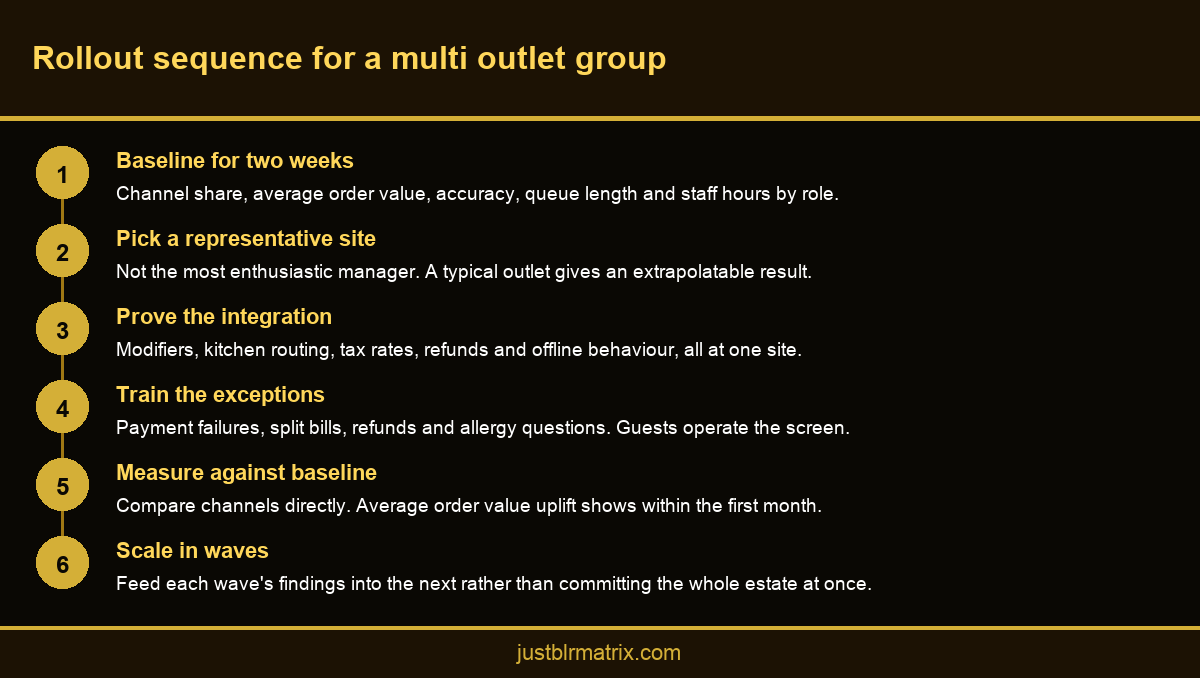
Start with one outlet and one format. Groups that roll out four formats across six outlets simultaneously cannot tell which decisions worked. A single site pilot with clear measurement produces a decision you can defend, and it surfaces the integration problems while they are still cheap to fix.
Pick the pilot site for representativeness rather than for enthusiasm. The outlet with the most engaged manager will make anything work, which tells you nothing about the rest of the estate. A typical site with typical staffing gives you a result you can extrapolate.
Define the measurement before the hardware arrives. Channel share, average order value by channel, order accuracy, queue length at peak and staff hours by role. Baseline all of them for two weeks first, because without a baseline every subsequent number is an assertion.
Fix the integration completely before scaling. Modifier handling, kitchen routing, tax rates, refunds and offline behaviour should all be proven at one site. Rolling out an integration gap to twelve outlets turns a small problem into a project.
Then scale in waves with a feedback loop between them, and sequence the rollout alongside the rest of your automation plan. Self service interacts with kitchen throughput and with service robotics, so the hospitality automation overview is worth reading alongside this before committing a group wide budget.
Conclusion
Restaurant self service automation works in India when it is treated as a settlement problem, integrated into one order source of truth, and matched to the right format for the venue. Choose between kiosk, tabletop tab, counter checkout and vending on the basis of where the guest is standing, prove the integration at one representative site, and plan the staff redeployment rather than assuming a saved salary. Get a quote to scope a pilot.
Frequently Asked Questions
What is restaurant self service automation?

Which self service format suits my venue?
Does self service actually increase average order value?
How does a kiosk handle GST invoicing?
What happens if the internet connection drops?
Will I be able to reduce staff?
Should I keep a staffed counter as well?
How should a multi outlet group roll this out?
How does self service connect to guest recognition?
What is the biggest mistake operators make?